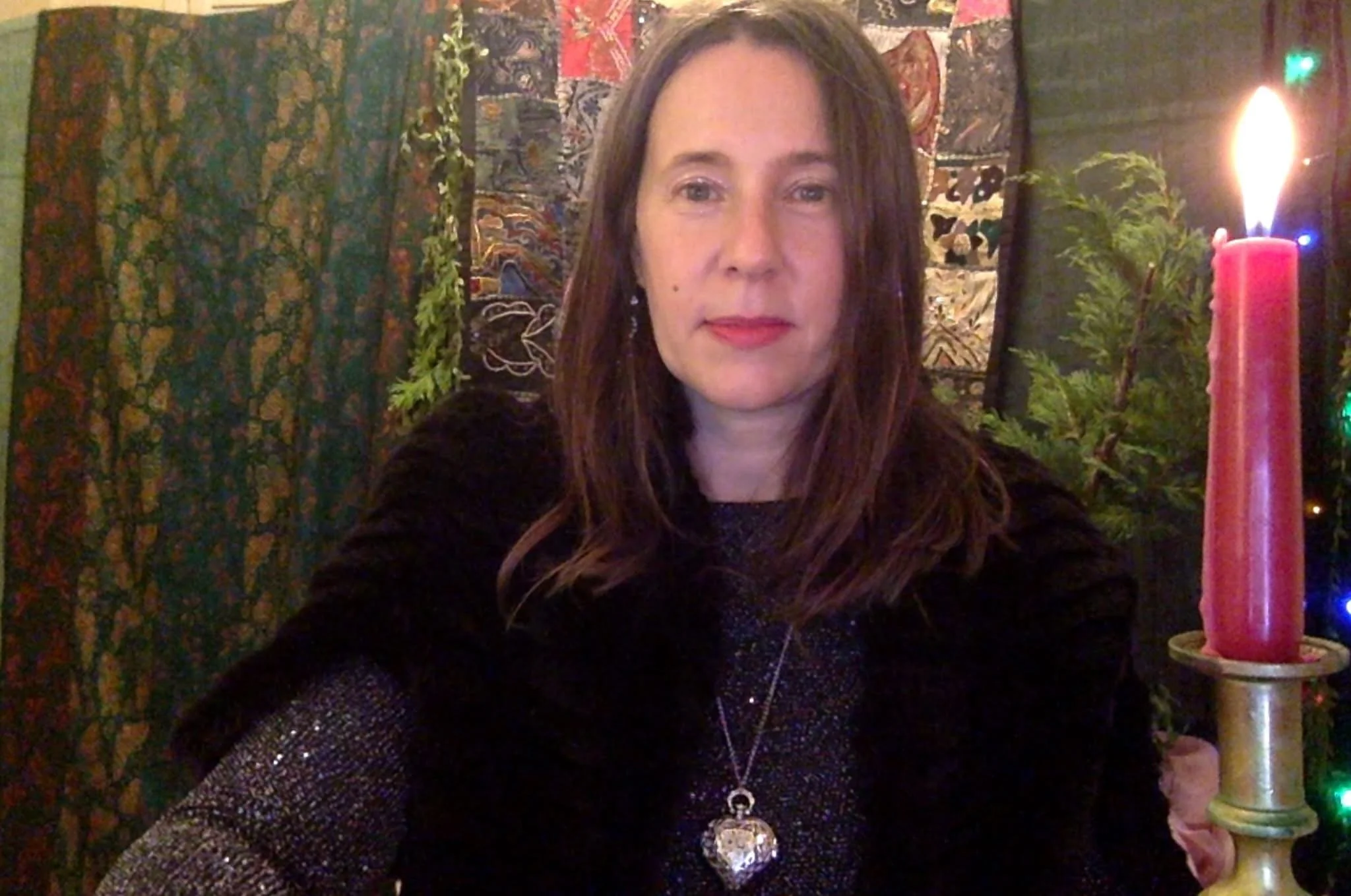
How to Run an Event on Zoom (That Actually Feels Like Being Together
(this blog has been transcribed from the Audio version if it sounds a bit weird, that’s why)
I first started running online gatherings way back in 2007, when it was the Joy Group on Skype. A small circle of us — I’d created it, envisioned it, made it happen — just sharing where we were at, what we were going through. And it served to create this small community with a deep sense of belonging. Like a little family. People who cared about each other and were able to give really useful feedback and support whilst we navigated our new businesses and our emotional lives too.
I am a person who has the ability to feel — Skype, Zoom, other online platforms — as extraordinarily similar to being in person together.
And I say this as someone who was absolutely adamant that they would not be doing anything online and that all events needed to be run in person, because that’s where you get the connection, where you can experience the senses — smell, taste, touch — and you have the tangible quality of something that’s quite intangible. But because I was always doing intuitive readings, I used to do those over the phone. And later, when COVID happened, I was having cranial sacral therapy on Skype. So as a very sensitive, ‘feeling’ facilitator, I recognised that online has an equal capacity to feel connected.
Then 2020 came. My 50th birthday — which was going to be a weekend for 50 people in the Somerset countryside, in the kind of shadow of the Glastonbury Tor, where I’d got musicians and a DJ and dance teachers and gong baths and food and beautiful exercises and fairy trails — of course, it couldn’t happen.
So I created my first really beautiful structured event on Zoom. I sent everybody a beautifully wrapped, shiny, pretty envelope in the post with paraphernalia inside that was going to support what I’d created to do on my birthday Zoom. I’ve always loved integrating online and offline activity. When I run events on Zoom, I very often send people stuff in the post — it’s a beautiful surprise and a delight for me to create and just part of my whole creative process.
And actually, looking back to 2008, 2009, when I was starting to run the Events of Love, they always began with “Can I have your postal address?” because I used to send rose-scented, deep red, gold-embossed invitations through the post. When you come to my events, you will find delightful surprises like that. I’m really interested in the sumptuous, sensual texturisation of our senses. And I like to integrate that with my online work.
So I had found this kind of etiquette for Zoom, which I shared with all my participants for my birthday. And we were off.
However, that day — the 4th of April 2020 — Zoom just combusted. I think a lot of people were using it. So my birthday party didn’t happen. But what did happen was a really deep thought process. I was really working out how to translate a party of 50 into a smaller party — albeit a smaller party of like 12 or 15 — on Zoom. And I went into this quite deeply.
And you know what people have said about my Zooms? They forgot they weren’t all in the same room together. That’s show the level of connection we are capable of.
The Big Realisation: Ultimate Freedom Comes From Structure
I am a person who does not come across as particularly structured or strategic. For years and years I remember exploring flow states — how to get into flow, how to remember stuff, how to schedule stuff, how to make sure things got finished. Because I have so many ideas. Some of them come to light, some of them don’t.
And actually, I think part of my experience of doing this MA at this late stage in my life has been about helping me to really understand and recognise how I work, what the creative process is like, and where flow actually comes from.
I can remember some years ago running some Zoom events where I got into a really horrible disagreement with one of the participants who was just furious with my wanting regularity in our meeting schedule. Saying that nature is all over the place, and there’s no structure there.
Which is completely the opposite, of course.
Because we have the very fundamental structure of the universe, which is the sun rises every morning and sets every night. And then we get to see the sun shining on the moon. So we have day and night. We generally on the whole have a full day of light and then a full night of dark. Those are two completely different states.
We have the moon — all of our seasons. And the moon goes through its pattern of full to new and all the different phases in between. The moon affects the tides, the water, our bodies. We are in a structure of autumn, spring, summer, winter. We’re in a structure of birth and death. You can’t get more structured than nature.
The leaves fall every autumn and we grow again every spring. The bees pollinate the plants and the flowers. Structure is the fabric of reality. I was kind of blown away to recognise and realise this.
So my realisation — that ultimate freedom and flow come from structure — has totally informed the way I run events on Zoom. I think having a very clear structure is more important on Zoom than even in person, because we are on Zoom. The more clear you are, the more free you are able to be.
The Method: How To Actually Do It Properly
Before anyone arrives
I cannot abide small talk. Chitter chat. I wanna go deep right away. I wanna know like who you really are. I want to know what’s really going on for you. I want to share who I am. And I also want things to slow down long enough to hear, to smell, to be part of. I love stopping to smell the roses. I hate introducing people with a list of awards and accolades. I don’t guage others by that. I go by how I feel when I am with them. So I might say, if introcuign someone “the is Aliza and she’s having an the first exhibition of her paintings soon” or “this is Leo and he is someone who has taught me a lot and who I love a lot”, or this is Francesca, someone who I find deeply inspiring and so on.
Small talk at events is really hard and quite unpleasant — and even worse on Zoom.
So I send a list of instructions before the event so people know they are entering a separate space, a separate room — just as if it were a literal room.
Tell them to:
Put away their phone
Finish their dinner
Have a glass of water
Be sitting, present, ready
The arrival — this is crucial
When people arrive on the Zoom:
All microphones are muted
Music is playing — a playlist I’ve created designed to connect, relax, and still the mind. (have a look at some of my playlists here.
People come in, sit, put their feet on the ground, breathe, listen to the music
You come into the room, the Zoom room, and you sit like you would in a real workshop space. Close your eyes. Come into the present moment. Wait for everybody to arrive.
At my Events of Love in person, when you arrived you were greeted beautifully — with a spritz of rose courts crystallescence that I’d made, just to ground you, open your heart, and get you into the right environment straight away. And then straight away we would play the envelope game. Some people still have those envelopes, you know, 15 years later. So you can come on your own. You don’t have to feel left out or intimidated. You’re warmly welcomed and given an activity — a bit like a more formal corporate icebreaker, but with my little waves of rose petal and inspiration put in.
On Zoom, the music does that work.
Have an assistant. I cannot stress this enough. The technicalities of managing Zoom — sharing screens, managing music, watching the chat, letting people in, dealing with glitches — is a separate job. You are going to be doing quite a lot. It’s really useful if you can have someone else handling the mechanics while you hold the space.
Lock the room
When you’re ready, lock the room. You can have 15 minutes at the beginning for gentle arrival, but after that, the door is closed. People coming in and out is too distracting. You can’t have it.
The welcome
Don’t say “Oh hi everyone, how are you?” That is not how to open a Zoom circle.
Go around and say everybody’s name. Look at each person as you do: “Hello Katrin. Hello Brian. Hello Sophie. Hello Emily.” Then introduce the space: “Hi, welcome to the Events of Love. I’m really glad to see you all here today.”
Get them moving — first thing, before anything else
Before any sharing, before any teaching, before any of the “content” — get them up. Get them dancing. Get them shaking. Get them into their body. I’d always say never create without dancing. Or never do a talk without moving first.
I always put movement into everything I do because there’s absolutely no point being completely in our heads about all this. I always want to shake the day off. Always want to dance. Whenever I run a workshop, whenever I do a talk, I dance and shake beforehand. And if I can’t, I get into that straight away at the event. Once I’ve moved, once I’ve danced to one track, I’m better. I’m okay. I’m not so nervous. I’m in my body. I can speak then.
And of course, you’re doing this for yourself too. Any nervousness, any fear about running on time, finishing on time, people being late, what am I gonna say, oh my god what if I can’t connect with them — give it to the dance. Give it to the floor. Shake it out.
You’ll see the energies change before you’ve even got back to your chair.
Ground and centre
Come back. Take three deep breaths together. Let them come into the moment. Feel the body. Let the thoughts go. Everything you were thinking about five minutes ago — leave it for the moment. Bring your attention into your body. Notice where you’re breathing. Do a quick body scan. Ground and centre.
The sharing
Go around. “I’d love to hear your name. Why are you here? How you’re feeling.”
Make the guidelines super clear:
Camera on
No eating, no smoking, no drinking, no alcohol, no drugs — same as an in-person workshop
Only one person speaking at a time
Very clear beginning and end so we know when you’ve finished
Tell them what to say when they’ve finished
Use actions on Zoom so the person feels heard — the sign language clapping, the waving of hands like a love shower, so they feel really seen and heard.
You can time the shares — “you’ve got three minutes” — or let it flow. It depends how much you trust yourself. There are multiple ways to do this.
The body of the event
Then you facilitate your next process — whether that’s a meditation, a teaching, an exercise. Incorporate movement, sharing, activities.
Give instructions three times, clearly. For example: “We are now going to go outside and burn the paper. And when you’re burning the paper, I want you to really watch the smoke, see the image, the picture of what that smoke makes.”
If people are going off-screen for an activity, play music for that period. When the time is up, they come back and you’re sitting there with the music. You can send them a playlist in advance.
Breaks and breakout rooms
If it’s over an hour — especially if it’s an hour and a half — you need breaks. Time for movement. Time for breakout rooms so you’re not all just sitting staring at the screen the whole time.
The love pulse (virtual version)
I also do a virtual version of the love pulse. The love pulse is where we rub the palms of our hands together. The palms of the hands are part of the body that is really connected to the heart, and it’s easy — you don’t have to take your clothes off to get to that. It’s not like the genitals. You rub your palms together and then you can all connect energetically that way, on Zoom.
In Summary
Believe it’s possible to create the same level of connection online as in person. Your own belief is the foundation.
Structure creates freedom — clear beginnings, middles, and ends. The more clear you are, the more free you are able to be.
No small talk — music on arrival, straight into presence. Don’t let people chitter chat their way out of the magic.
Move first — dance, shake, get into the body. Before anything else.
Have clear guidelines — share them in advance, enforce them with love.
Get an assistant — managing the tech is a separate job. You need to hold the space.
Integrate the senses — send things in the post if you can. Make it sumptuous.
Have a beginning, a middle, and an end. Welcome. Body. Close. Every time.
I will always love running events in person. But that doesn’t stop me running them on Zoom — because it means you can come from a different time zone, from around the corner or across the world. You don’t have to spend money on travel and accommodation. You can just come.
I’m just really grateful for Zoom. I think it’s one of the magical 21st-century tools we have at our fingertips that we can really use as a connection tool.
So let’s use it. Properly.